Product 03
DigiTransform.
Modernize fragmented data across generations. State-of-the-art AI ETL pipelines engineered specifically to handle the extreme irregularities of historical heritage datasets.
Generational
Data Decay
Museum datasets are rarely built in a single era. They are compiled, appended, and transferred across decades, sometimes centuries. The result is a patchwork of information that spans handwritten physical ledgers, legacy proprietary database exports, fragmented Excel spreadsheets, custom flat-file formats, and outdated SQL dumps.
Over this time, geographical boundaries shift, countries change names, taxonomic ontologies are rewritten, and data entry standards evolve. This results in datasets plagued by extreme sparsity, missing fields, and semantic inconsistencies, placing an impossible burden on collections staff who must navigate years of contradictory records just to answer a single research query. This is, in practice, the single greatest bottleneck preventing institutions from unlocking the full scientific value of their collections.
Standard commercial ETL (Extract, Transform, Load) tools are rigid. They expect structured corporate data. They collapse entirely when faced with the nuanced ambiguity of 200 years of scientific collection records.
Semantic
Normalization
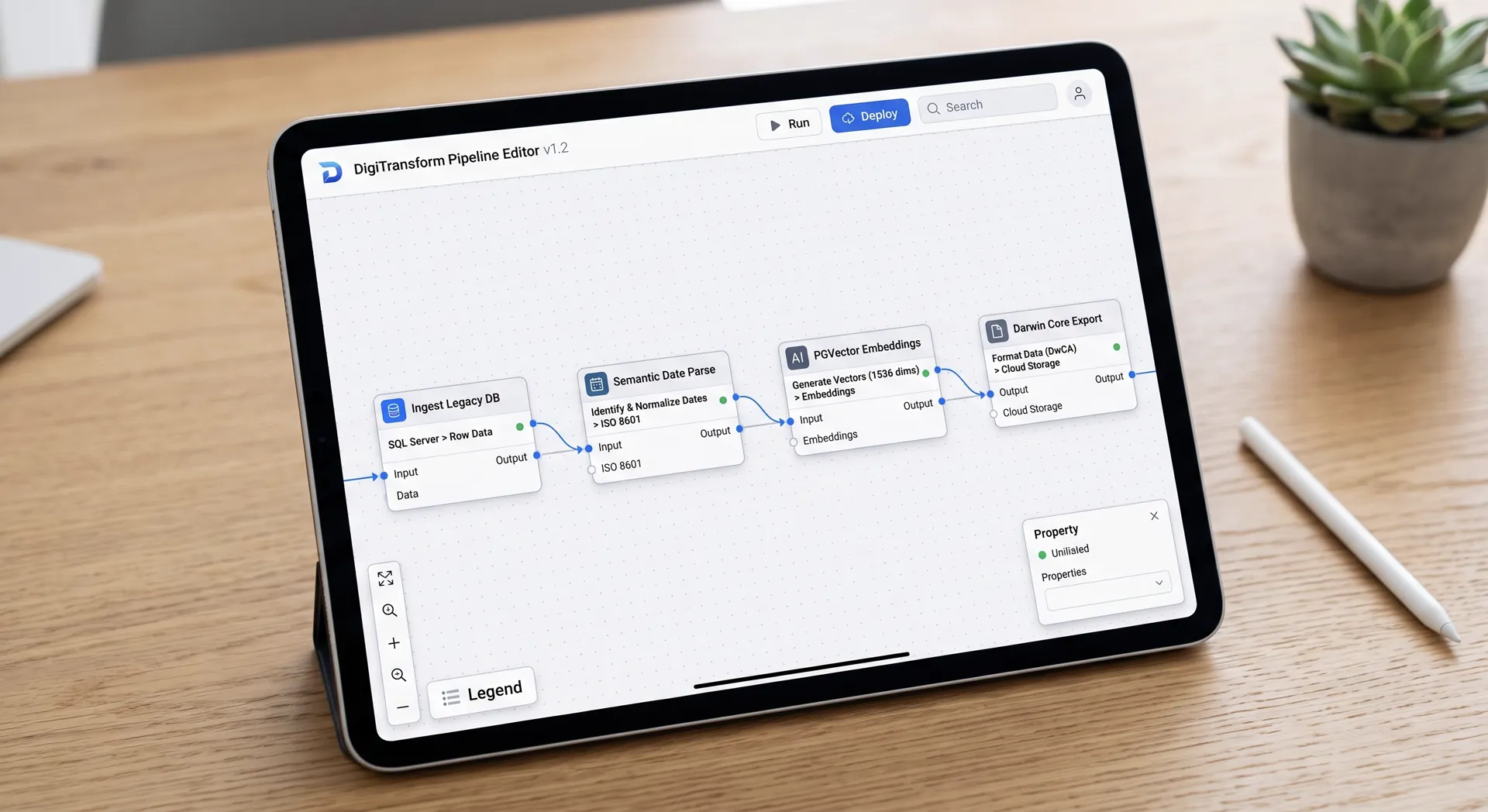
DigiTransform is built specifically for the chaos of heritage data. By deploying an array of Large Language Models (LLMs) alongside strict, rule-based extraction templates, the platform possesses the semantic understanding required to infer context from fragmented data.
It can intelligently split merged fields, normalize archaic date formats, resolve historical location names against modern geocoding lexicons, and map the resulting clean data into universally accepted relational schemas like Darwin Core.
Result: Seamlessly bridge historical record-keeping with contemporary, highly relational data ontologies, making your entire archive instantly queryable.
No Cloud.
No Exceptions.
The AI at the core of DigiTransform runs entirely within your institution's own network. Every LLM inference call, every semantic resolution decision, every field transformation, all executed on your hardware, behind your firewall. No data is transmitted to any external cloud service at any point in the pipeline.
This is a fundamental architectural principle, not a configuration option. For institutions with strict data governance obligations, legal data sovereignty requirements, or simply a principled stance on the custody of their collections data, DigiTransform provides the only ETL solution that genuinely guarantees your heritage data never leaves your premises.
Result: The full power of frontier AI for heritage data transformation, with complete, unconditional data sovereignty.
Agnostic Ingestion
Natively parses a broad range of unstructured and legacy source formats including CSV, JSON, XML, Excel, Microsoft Word tables, proprietary database exports, legacy flat-file formats, and SQL dumps, handling the widest possible range of historical data formats without requiring pre-processing.
Local AI Engine
Deploys a hybrid architecture of deterministic rule-based extraction templates and Large Language Model inference for semantic ambiguity resolution. Critically, all LLM inference runs entirely within your institution's local network; no transformation request, field value, or specimen data is ever transmitted to an external API endpoint.
Deep Normalization
Automatically resolves heterogeneous date formats (including verbal, partial, and historical calendar variants) to ISO 8601. Resolves historical geographic place names to their modern equivalents and WGS84 coordinates. Infers missing mandatory fields from surrounding contextual data, with documented confidence thresholds surfaced for human review.
Collector Standardisation
Normalises collector names across variant spellings, abbreviations, and name changes spanning data generations. Institution names and identifier codes are standardised against configurable authority records. All normalised entities are indexed for cross-collection query and cross-institutional deduplication, so a single collector's specimens can be found regardless of how their name was recorded across two centuries of entry.
Vector Embeddings
Generates high-dimensional vector embeddings for entities and stores them natively in PostgreSQL using PGVector, enabling advanced semantic search and entity resolution across your full transformed dataset without a separate vector database product.
Relational Export
Outputs transformed data to Darwin Core relational schema for GBIF submission, CSV with institution-defined field mapping, and direct SQL insertions into your existing CMS database, eliminating manual re-entry between systems.
Access Control
Role-based access control (RBAC) with four permission tiers: Administrator, Curator, Researcher, and Read-Only. Full integration with institutional LDAP and SAML 2.0 identity providers, enabling single sign-on within your existing IT infrastructure.
Data Sovereignty
Fully self-hosted and air-gapped capable. The ETL pipeline and all AI model weights operate entirely within your institution's secure network; no data leaves your premises at any stage of ingestion, transformation, or export. Full functionality is guaranteed with zero internet dependency.
Cryptographic Audit
Maintains a cryptographic hash-chained transformation history providing complete traceability from every raw ingest value to its final normalised output, exportable for academic peer review and institutional data governance audit at any time.
Ready to Deploy
Bring DigiTransform
to your institution.
Speak with our team about a tailored implementation for your collection. We work directly with curators, registrars, and IT infrastructure teams.
Request a Consultation