Product 02
DigiTrack.
Spatial intelligence for massive physical collections. Deploy passive tracking for up to 50 million specimens with 99.999% accuracy, without relying on a single active hardware sensor.
The
Scale
Problem
Museum collections are dynamic environments. Specimens are constantly being moved for active research, public exhibitions, loan processing, and institutional audits. Knowing the exact location of a single specimen among 50 million is a logistical nightmare.
Traditional asset tracking solutions rely on active hardware like Bluetooth Low Energy (BLE) or active RFID tags. When scaling to tens of millions of assets, these active solutions fail catastrophically: the hardware cost runs into the tens of millions of dollars, the radio interference makes precision impossible, and managing battery replacements across millions of units requires impossible levels of maintenance.
A true museum-grade solution requires infinite scalability with zero maintenance overhead.
The DigiTrack Mandate: Any specimen, anywhere in the institution: locate it, move it, search for it, and find it instantly. No confusing paper trails, no dependence on institutional memory, no guesswork. A fully modernised spatial ledger with the search capacity to locate any specimen in seconds.
Zero Active
Hardware
DigiTrack flips the traditional tracking model entirely. Instead of putting expensive active sensors on the specimens, we place custom-designed fiducial markers on the specimen containers. These markers cost a fraction of a cent to print, require zero power, and never degrade.
The active intelligence lives in the mobile devices your staff already carry. By utilizing native device LiDAR depth sensors and high-resolution optical capture, the DigiTrack mobile application scans the room continuously as staff go about their daily routines. The system registers opportunistic sightings of tags passively from up to 6 metres away, instantly updating the central spatial ledger without any deliberate scanning action required.
Result: Near real-time visibility across your entire institution at an unprecedented scale, mapping the room passively without touching a single drawer.
AR
Drawer
Audit
DigiTrack introduces a powerful visual audit capability that turns any mobile device into a collection verification tool. A single reference photograph of a specimen drawer establishes a permanent spatial baseline, recording the precise position of every specimen within it.
On any subsequent visit, the DigiTrack mobile application overlays a live AR comparison against that reference image in real-time. The system instantly highlights any specimen that has shifted from its catalogued position, and flags any empty space where a specimen should be present but is not. What previously required a curator's memory, a printed catalogue, or a painstaking side-by-side comparison can now be verified in seconds, from a single handheld scan of the open drawer.
Result: Loan returns, post-research audits, and routine collection integrity checks that once took hours can be completed passively as part of any routine drawer inspection.
Instant
Discovery
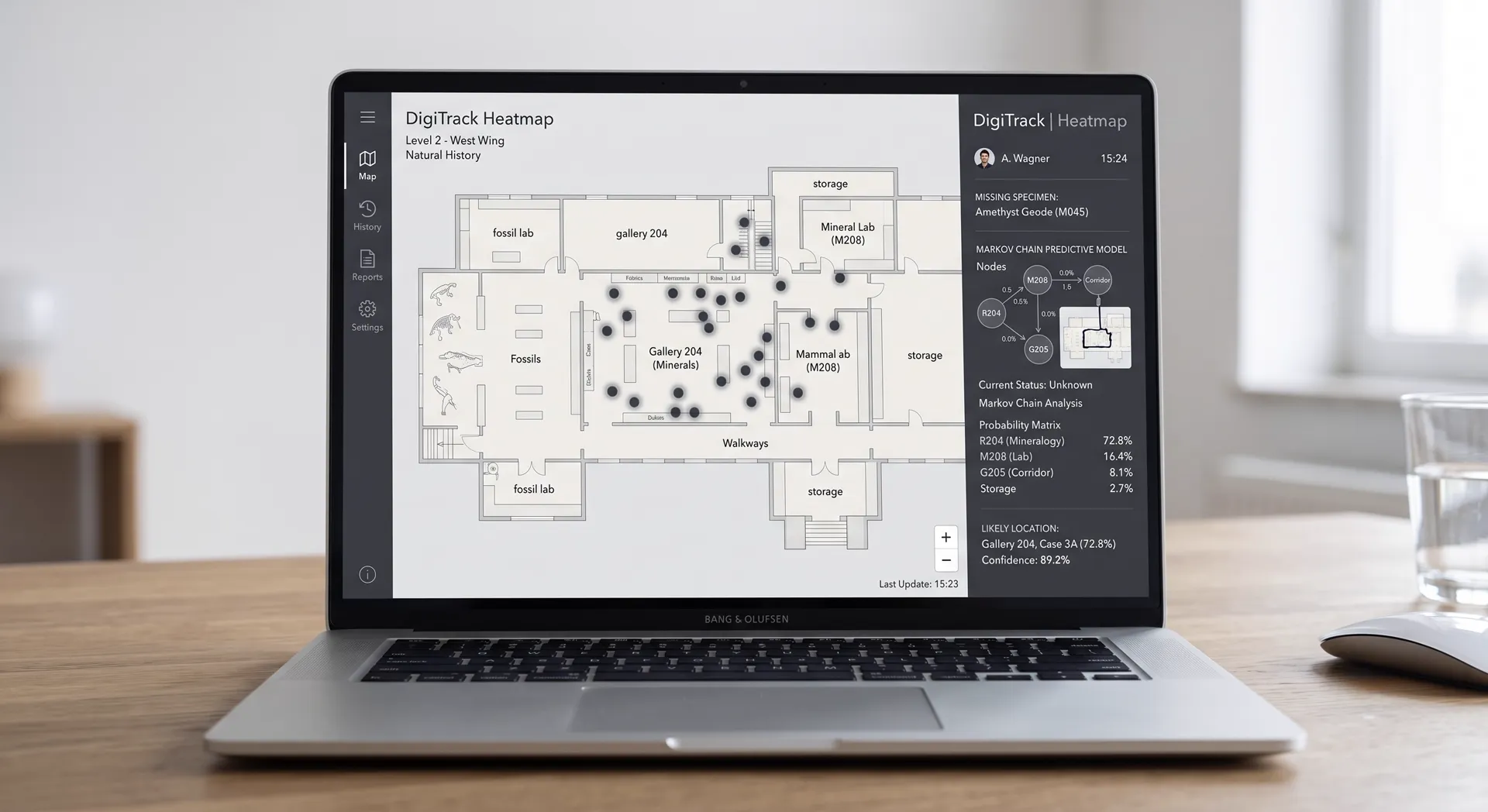
Any authorised user (curator, registrar, researcher, or collections technician) can locate any specimen container in the institution within seconds. Search by specimen identifier, taxon name, or collector name. DigiTrack returns the current confirmed or predicted location on a live room map, along with confidence status and the last confirmed sighting timestamp.
Critically, this capability exists entirely independently of institutional memory. The location of a specimen does not depend on who moved it last, whether that person is available, or whether anyone remembers. The spatial ledger holds that knowledge permanently, and it is available to any authorised terminal on the network at any time.
Result: Any specimen, located in under 3 seconds. From any device. Without asking anyone.
Complete
Movement
History
DigiTrack's ledger is strictly append-only. Every location observation is recorded permanently from the moment a container is first tagged. No entry is ever modified or deleted. The result is a complete, unbroken spatial biography of every specimen in your collection: every move, every loan departure, every research desk visit, every return.
This is transformative for loan management and institutional audit. When a specimen is returned from loan, DigiTrack confirms its exact reinstatement position. When an institutional audit requires a complete movement report for any object, the full history is available and exportable instantly; no manual logs, no reconstructed spreadsheets, no gaps.
Result: A complete, court-admissible chain of custody for every specimen your institution holds, generated automatically as a by-product of normal daily operations.
Tracking Engine
Powered by a custom spatial marker dictionary generating 2,000,000 unique container IDs, sufficient to individually address every object in even the world's largest natural history collections. Engineered with a Hamming distance of ≥7 between any two valid codewords, guaranteeing zero false-positive reads under adverse conditions including oblique angles, partial occlusion, and low ambient lighting.
Spatial Mapping
Native device depth sensor integration constructs a high-fidelity, real-time 3D topographic map of your collections floor. The room model persists and updates incrementally with each new scan session, building an increasingly precise spatial reference without dedicated surveying equipment or specialist personnel.
Passive Capture
The mobile application continuously extracts and processes high-resolution frames from the camera feed as staff move through the collections, detecting and decoding markers opportunistically from 4–6 metres away with no deliberate scanning action required. Observations are uploaded to the central ledger in real time over the local network.
AR Drawer Audit
A single reference photograph of any specimen drawer establishes a permanent spatial baseline. The DigiTrack mobile application uses computer vision and AR overlay to compare any live camera feed against that baseline in real-time, detecting displaced specimens and flagging missing specimens with precision, without the need for manual catalogue cross-referencing.
Specimen Search
Any authorised user can locate any specimen container by identifier, taxon name, or collector name, with results returned in under 3 seconds against a 50 million specimen collection. The current confirmed or predicted location is displayed on the live room map with confidence status and last-sighting timestamp.
Predictive AI
When a container has been moved but not yet re-observed, a Markov Chain predictive routing model analyses the full historical ledger and known movement patterns to estimate the most probable current location. Predicted locations are surfaced with explicit confidence intervals and clearly distinguished from confirmed observed positions.
Immutable Ledger
All location updates are strictly non-destructive and append-only; no record is ever overwritten or deleted. The system maintains a complete, unbroken spatial history of every container from its first registration, providing a permanent chain of custody that satisfies the requirements of institutional audit, loan management, and academic provenance.
Loan & Audit Reporting
Generate complete movement reports for any specimen or container across any date range, exportable in machine-readable formats for institutional audits, loan condition reporting, and insurance documentation. Reports include every confirmed sighting, movement event, and predicted location estimate with associated confidence scores.
Access Control
Role-based access control (RBAC) with four permission tiers: Administrator, Curator, Researcher, and Read-Only. Full integration with institutional LDAP and SAML 2.0 identity providers for single sign-on within your existing IT infrastructure.
Data Sovereignty
100% self-hosted and air-gap capable. The entire platform (spatial ledger, room models, and mobile application backend) operates entirely within your institution's private network. No location data, room geometry, or institutional mapping is ever transmitted to external cloud services.
Data Privacy
DigiTrack stores zero specimen taxonomic or descriptive data. It operates strictly as a spatial container ledger, querying specimen identity from your institution's primary database live at the point of display. The spatial and collection systems are architecturally separated; a breach of one cannot expose the other.
Ready to Deploy
Bring DigiTrack
to your institution.
Speak with our team about a tailored implementation for your collection. We work directly with curators, registrars, and IT infrastructure teams.
Request a Consultation