Product 01
DigiLabel.
The definitive solution for unlocking the world's dark data. Extract structured taxonomy from millions of complex specimen labels (handwritten, printed, curved, multi-part, or multi-lingual) using advanced Vision AI.
The
Biodiversity
Bottleneck
World-class museums collectively house billions of physical specimens, but the vast majority of the data attached to them remains trapped on small, fragile paper labels, in forms that range from handwritten ink to printed text, curved jar labels, multi-part tags, and aged typeset catalogues.
These labels span hundreds of years, dozens of languages, shifting taxonomic standards, and varying degrees of legibility. Traditional Optical Character Recognition (OCR) fails completely on this unstructured, heterogeneous data. Consequently, manual transcription is the only alternative: a process that is prohibitively expensive, excruciatingly slow, and prone to human error.
Until this dark data is digitized, it cannot be queried. The inability to rapidly index these collections creates a massive bottleneck for modern academic research, impeding critical studies on climate change, evolutionary biology, and biodiversity loss.
The
Intelligent
Pipeline
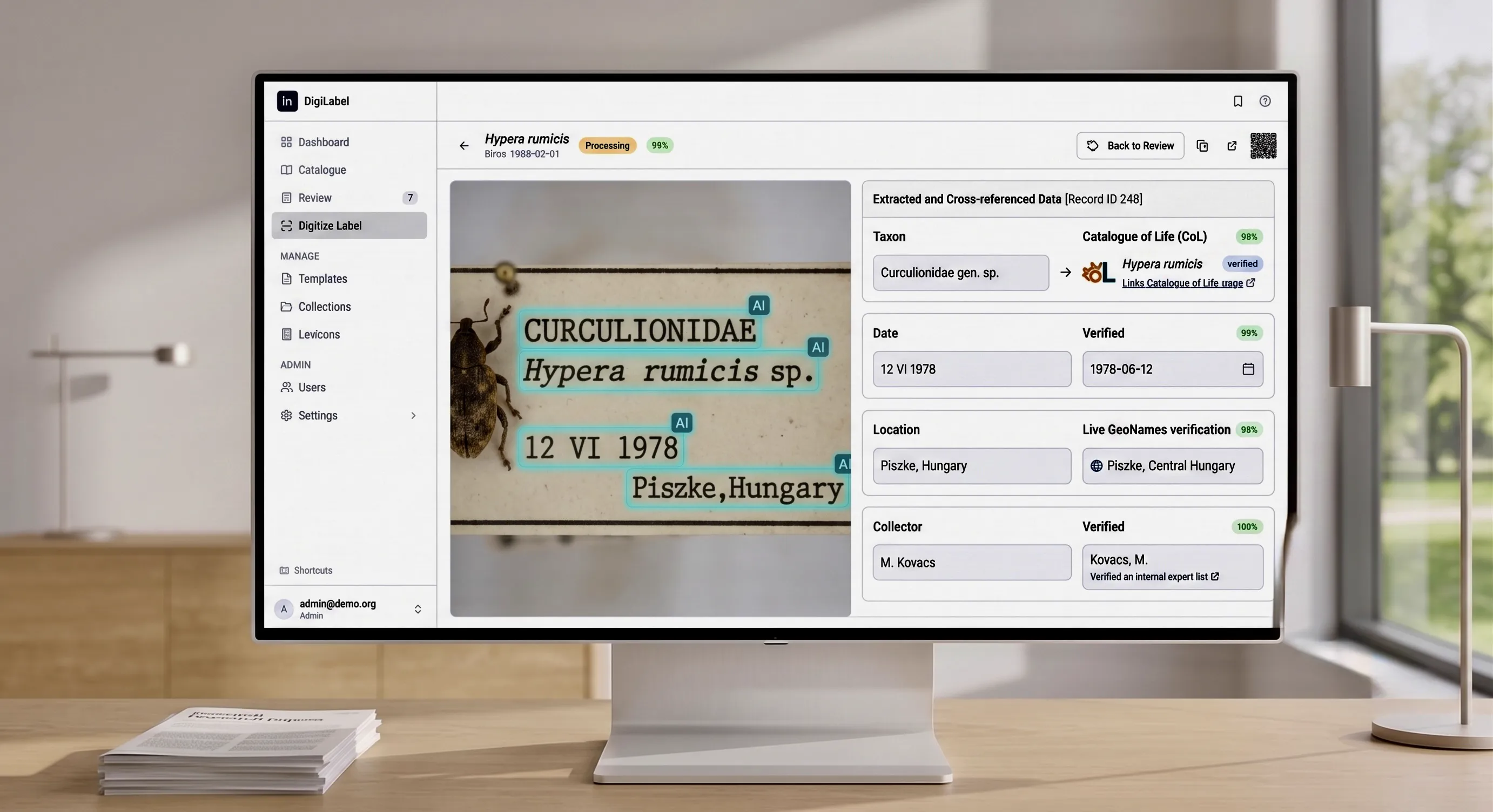
DigiLabel replaces the manual transcription bottleneck with an intelligent, AI-powered pipeline designed specifically for the rigorous standards of natural history institutions.
The platform ingests massive batches of label images (including multi-image specimens, curved jar labels reconstructed from multiple angles, and scanned PDF catalogues) and leverages advanced Vision AI models to instantly parse and extract structured data fields. DigiLabel automatically cross-references extracted entities against global authority lists such as the Catalogue of Life, using sophisticated matching and diacritic handling to ensure taxonomic accuracy despite historical misspellings. Critically, the pipeline also performs baseline standardisation of institutional metadata, normalising collector names, institution identifiers, and date formats against established authority records to ensure consistent, queryable data from the first ingest.
Language is not a barrier. The OCR and extraction engines natively support a minimum of eight languages including English, Latin (classical and scientific), German, French, Spanish, Portuguese, Dutch, and Russian, covering the full scope of European natural history scholarship from the 18th century to the present. Archaic abbreviations, historical spelling conventions, and pre-modern scientific nomenclature are handled without manual configuration.
Result: Accelerate your institution's digitization velocity while reducing transcription costs by up to 90%.
Curators
Stay
In Control
DigiLabel is not a black box. Every field extracted by the AI is presented to your research team with a per-field confidence score. High-confidence fields are accepted in bulk. Lower-confidence fields are surfaced for human review, allowing your curators to verify a prediction rather than type data from scratch. This is dramatically faster than manual transcription, while keeping your specialists in command of the final record.
The system enforces append-only record semantics. No data is ever overwritten or deleted; every correction, every AI prediction, and every human edit is permanently logged in a cryptographic audit trail. Your institution retains a complete, immutable provenance chain for every specimen record, satisfying the most rigorous academic and data governance requirements.
Result: AI speed with curatorial authority. Your team verifies; the system learns.
Entity Resolution
Advanced fuzzy matching with native diacritic handling resolves historical spelling variants, deprecated synonyms, and abbreviated names against built-in global authority lists and your institution's own custom registries.
Taxonomic Integration
Automatic, real-time cross-referencing with the Catalogue of Life to validate extracted taxa against modern accepted nomenclature. Collector names and institutional identifiers are simultaneously normalised against configurable authority records.
Automated Geocoding
Intelligently parses historical, colloquial, and archaic locality text, converting descriptions such as "British East Africa, 3 days north of Mombasa" into precise WGS84 decimal coordinates. Geocoding runs entirely within your network using a self-hosted geocoding engine; no locality data ever leaves your premises.
Multi-language OCR
Full OCR and extraction support for a minimum of eight languages: English, Latin (classical and scientific), German, French, Spanish, Portuguese, Dutch, and Russian. Archaic spelling conventions, historical abbreviations, and pre-modern scientific nomenclature are handled natively across all supported languages, without any manual configuration between document batches.
Academic Review Workflow
A human-in-the-loop review interface presents every AI-extracted field alongside its confidence score. High-confidence extractions are accepted in bulk; lower-confidence fields are queued for expert verification. Researchers verify predictions rather than transcribing from scratch, which is dramatically faster while maintaining full curatorial authority.
Data Integrity
Append-only record architecture ensures no data is ever overwritten or permanently deleted. Every AI extraction, human correction, and batch update is permanently recorded in a cryptographic hash-chained audit trail, providing an immutable provenance chain that satisfies academic peer review and institutional data governance requirements.
Export & Integration
Native export to Darwin Core Archive (DwC-A) for direct GBIF submission, and CSV with configurable field mapping. Direct SQL integration into your existing Collections Management System (CMS) is supported, eliminating the need for manual data re-entry across platforms.
Access Control
Role-based access control (RBAC) with four distinct permission tiers (Administrator, Curator, Researcher, and Read-Only) ensures that every member of your team accesses exactly what they need. Full integration with institutional LDAP and SAML 2.0 identity providers is supported.
Data Sovereignty
100% self-hosted and air-gap capable. The platform operates entirely within your institution's network; no specimen images, extracted data, or AI inference requests are ever transmitted to external systems. All authority list databases and AI model weights are locally bundled, ensuring full functionality with zero internet dependency.
Infrastructure
Built on a Rust (Axum) backend and PostgreSQL 16. Delivered as OCI-compliant Docker containers designed to run securely within private, air-gapped museum networks, deployable on your existing hardware without vendor lock-in.
Ready to Deploy
Bring DigiLabel
to your institution.
Speak with our team about a tailored implementation for your collection. We work directly with curators, registrars, and IT infrastructure teams.
Request a Consultation