Product 05
DigiModel.
Bring collections to life. Reconstruct highly accurate 3D models and physics-based skeletons directly from 2D specimen photography.
The Limits of
Flat Imaging
For centuries, museums have documented specimens using 2D photography. While excellent for capturing surface detail and color, flat images entirely lose the physical and spatial context of the specimen. The geometry, the articulation of joints, and the true volumetric proportions are flattened and lost to researchers.
Traditional 3D scanning solutions like structured light or micro-CT are prohibitively expensive, require extensive training, and often demand moving fragile specimens to specialized facilities. This restricts 3D digitization to only the most prized holotype specimens.
DigiModel fundamentally changes this paradigm. By leveraging advanced neural radiance fields (NeRF) and inverse rendering, it extracts volumetric depth directly from standard photography, making 3D digitization accessible for the entire collection.
Physics-based
Articulation
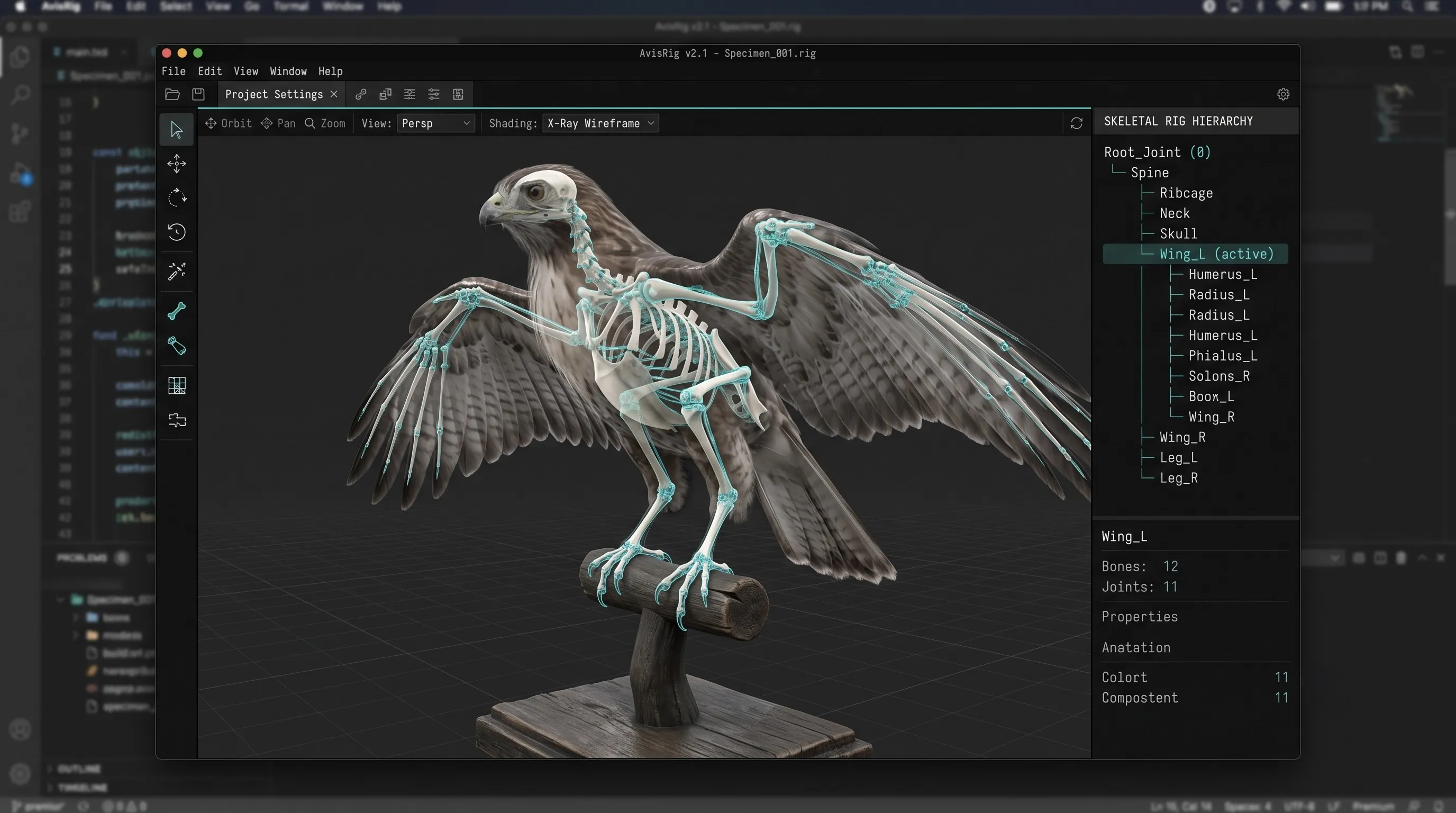
A static 3D mesh is only a partial solution. To truly utilize a model for education, biomechanical research, or animation, the model must understand its own physical properties. DigiModel automatically infers and generates physics-based skeletons within the reconstructed meshes.
This proprietary auto-rigging engine identifies anatomical structures from the visual data, assigning realistic constraints and weight painting to joints. Whether it's the wing hinge of a lepidoptera or the skeletal structure of a vertebrate, the generated models move naturally and accurately.
Result: Fully rigged, animation-ready 3D models generated automatically without requiring a technical artist.
Agnostic Input
Functions with as little as a single high-resolution image, though accuracy scales linearly with multi-angle datasets. Supports inputs from smartphone cameras, DSLR setups, or legacy archival photographs without requiring specialized calibration targets.
Physics Rigging
AI-driven semantic segmentation identifies biological structures and automatically generates a hierarchical skeletal rig. Inverse kinematics (IK) and physics constraints are applied based on the identified taxonomy, ensuring biomechanically plausible movement ranges.
Sub-millimeter Accuracy
When provided with multi-view photography containing reference scaling, the volumetric reconstruction achieves sub-millimeter geometric accuracy, suitable for rigorous morphological research and digital cataloguing.
Universal Export
Natively exports to modern, optimized 3D formats including GLTF/GLB, USDZ, and OBJ. Models are heavily decimated while preserving visual fidelity via baked normal and displacement maps, ensuring they are instantly ready for web viewing and AR deployment.
Local Processing
Like all ArchiveOS products, the neural network inference and mesh generation run completely on-device. Your unreleased specimen photography never leaves your network, guaranteeing absolute data sovereignty.
Ready to Deploy
Bring DigiModel
to your institution.
Speak with our team about a tailored implementation for your collection. We work directly with curators, registrars, and IT infrastructure teams.
Request a Consultation