Product 04
DigiBook.
Historical texts, reimagined as living databases. Preserve the physical geometry of complex expedition journals while deploying structural OCR and automated cross-linking.
Preserving
Context
Museums possess priceless historical context trapped within expedition journals, field notebooks, and centuries-old taxonomic catalogues. These texts often contain the foundational provenance for entire collections.
Currently, the standard digitization approach is to scan these books as flat, unsearchable PDFs, or to use basic OCR that strips away the layout. However, in historical documents, the page geometry itself is data. The spatial relationship between a sketched illustration, a margin note, and a taxonomic description is critical for researchers.
Flattening these texts destroys their interconnectivity and renders them isolated from the physical specimens they describe.
Living
Literature
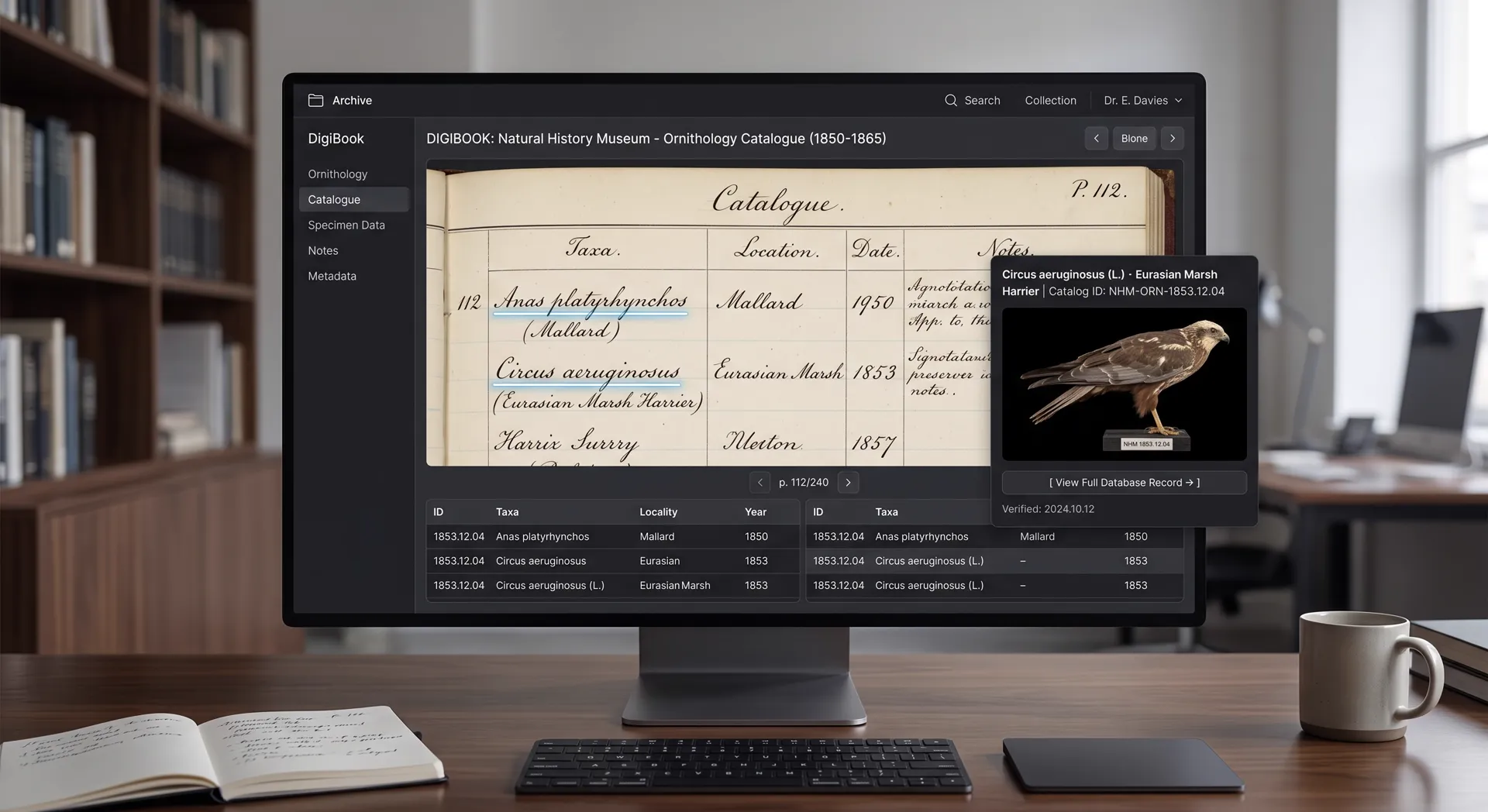
DigiBook is engineered to turn static historical literature into interactive, queryable data networks. It utilizes highly specialized structural OCR pipelines that are explicitly trained on faded, multi-lingual, and cursive typography.
As it digitizes the text, the system flawlessly preserves the original bounding boxes and page geometry. Furthermore, its Natural Language Processing engine automatically identifies specimens, locations, and taxa within the text, generating dynamic hyperlinks that cross-link the journal directly to your institutional database.
Result: A researcher reading an expedition journal from 1850 can simply click a handwritten species name to instantly view the physical drawer where that specimen resides today.
Result: A researcher clicks on a collector's name (say, Captain B, a prolific Victorian naturalist) and a cross-institutional library assembles itself: every bird, rock sample, and crustacean he ever collected, spanning multiple museums and disciplines, connected for the first time in a single queryable view.
Every
Document.
Every
Language.
DigiBook is designed to process the full diversity of documents held by a world-class natural history institution, not just the clean ones. Expedition journals and field notebooks. Taxonomic monographs and species catalogues. Hand-illustrated specimen plates with descriptive text. Multi-column printed catalogues with complex typographic layouts. Manuscripts with dense margin annotations. All processed through the same structural pipeline, geometry intact.
Language is not a barrier. The OCR and NLP engines support a minimum of eight languages including English, Latin (classical and scientific), German, French, Spanish, Portuguese, Dutch, and Russian, covering the full sweep of European natural history scholarship from the 18th century to the present. Archaic abbreviations, historical spelling conventions, and scientific nomenclature in its pre-modern forms are handled natively.
Result: Your entire historical literature corpus, regardless of age, language, condition, or typographic complexity, becomes a single, fully searchable, cross-linked research resource.
Geometry Preservation
Every recognised text element is stored with its precise bounding box coordinates relative to the source page. The structural relationship between illustrations, margin annotations, footnotes, and body text is explicitly encoded in the output data model , ensuring the spatial intelligence of the original document survives digitisation intact.
Document Typologies
Natively processes: expedition journals and field notebooks; taxonomic monographs and species catalogues; hand-illustrated specimen plates with associated descriptive text; multi-column printed catalogues with complex typographic layouts; manuscripts with margin annotations; and multi-page PDF catalogue scans. No pre-sorting or format-specific configuration is required between document types.
Structural OCR
OCR engines fine-tuned on 18th and 19th-century typographic styles, faded and degraded ink, complex handwritten cursive scripts, and multi-column catalogue layouts. Standard OCR that outputs plain text is not used; the full structural geometry of every processed page is preserved and stored alongside the extracted text.
Multi-language Support
Full OCR and NLP support for a minimum of eight languages: English, Latin (classical and scientific), German, French, Spanish, Portuguese, Dutch, and Russian. Archaic spelling conventions, historical abbreviations, and pre-modern scientific nomenclature are handled natively across all supported languages.
Automated Entity Linking
NLP engines continuously parse extracted text to identify and cross-link six entity types: taxonomic names (species, genera, families); geographic localities and expedition waypoints; collector and author names; date references; and specimen identifiers and register numbers. Each identified entity generates a live relational hyperlink to the corresponding record in your primary collections database. Cross-institutional resolution is supported: a single collector name in a document resolves to and aggregates all specimens collected by that individual across multiple institutional databases simultaneously.
Export Standards
Three native output formats for different institutional needs: TEI XML for academic archive submission and peer-reviewed publication; JSON-LD for linked open data publication and interoperability with external research platforms; and PDF/A with embedded text overlay for fully searchable preservation-grade PDF archiving. All three are generated from a single processing run.
Access Control
Role-based access control (RBAC) with four permission tiers: Administrator, Curator, Researcher, and Read-Only. Full integration with institutional LDAP and SAML 2.0 identity providers. Access to individual document collections, entity link databases, and export functions can be scoped by role.
Data Sovereignty
100% self-hosted and air-gap capable. All OCR inference, NLP entity recognition, and cross-linking runs entirely within your institution's network. Document images, extracted text, and entity databases are never transmitted to external cloud services. All model weights are locally bundled; full processing capability is maintained with zero internet dependency.
API Integration
Exposes a GraphQL API enabling dynamically generated entity cross-links to be consumed by your existing Collections Management System. The API supports authenticated, role-based access control. Full API documentation conforming to the OpenAPI standard is provided, enabling integration by your institution's own IT or research computing teams.
Ready to Deploy
Bring DigiBook
to your institution.
Speak with our team about a tailored implementation for your collection. We work directly with curators, registrars, and IT infrastructure teams.
Request a Consultation